The article Ethical Photojournalism: It's Authenticity and Impact, by John Kaplan of the University of Florida, raises several important issues relating particularly to photojournalists, although many of the ethical and moral considerations would no doubt apply also to fashion photographers, celebrity and portrait photographers... basically any photographer whose work involves them interacting with and reflecting on people as subjects.
The first few points raised revolve around your intention as a photographer. Kaplan asks whether anyone trusts press images to be truthful anymore, or if they are taken with a grain of salt, assuming that there would be some manipulation. Remaining true and unbiased towards a situation is important for a photojournalist, in order to be able to present an honest and accurate account to the viewer.
Working with integrity ties in with another issue raised by Kaplan, upholding the standard and respect for photojournalism as a whole. By understanding that our photography as photojournalists represents not only our personal offering, but also bears the name of our employer and everyone else working in the field, photojournalism can gain trust as a medium that represents facts.
Public perception can mean that viewers/readers/commuters can associate your images with honesty, information and meaning, or they can look with the assumption that there has been manipulation, or that they somehow being deceived.
One of the final issues raised by Kaplan one I found very interesting- that we as photographers need to be mindful that when we shoot a scene and identify ourselves as photographers, people's behaviour can change dramatically.
We need to ensure that in the pursuit of capturing that extra shocking, disturbing or taboo image, we are not encouraging a behaviour we know is ethically, morally or physically wrong or dangerous.
I will take for example the issue of photographing children smoking.
Below are four of the many different images I found by googling "children smoking", all by different photographers with presumably different intentions and situations.
Some people might argue that these children were smoking anyway, but by pointing a camera at them and encouraging this behaviour with attention (and personally, if it were me, picking my jaw up off the ground, much to their delight), could be rewarding and glamourising a dangerous habit to get into.
As photographers we need to be conscious not only of our surroundings, but also our effect on them.

Candy Cigarette
Sally Mann

New Year’s Eve, St. Jacques, Perpignan, 2006
Photographer unknown
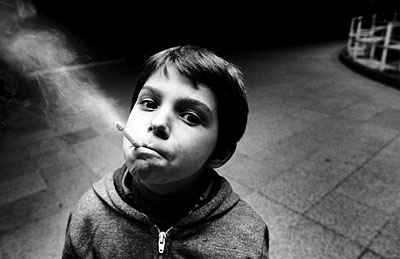
Sergei: The Airport is His Home.
John Kaplan

Title unknown
Candy Cigarette and New Year's Eve
Photojournalism and documentary photos
© 2009-2010 Artsy Spot. All Right Reserved.http://artsyspot.com/
Sergei: The Airport is His Home.
John Kaplan
"Title unknown" image
Why children and teens smoke?
© 2002 The ArticlE

Excellent summary of Kaplan's main points - well done! And the examples you found are so interesting - I agree completely with the point of becoming an accomplice to the action - but also, is everything that is photographed a "promotion" of the action or do you think that it might have the opposite effect, i.e. shocking people and causing action against what is depicted. Certainly that is something that photographers like Larry Clark might have considered. Look at his images here: http://www.larryclark.us/
ReplyDelete